Buyer-intent keyword strategy
Research focused on searches that signal a project: “software for”, “vendor”, “pricing”, “alternative to”, “integration with”.
B2B, SaaS & professional services
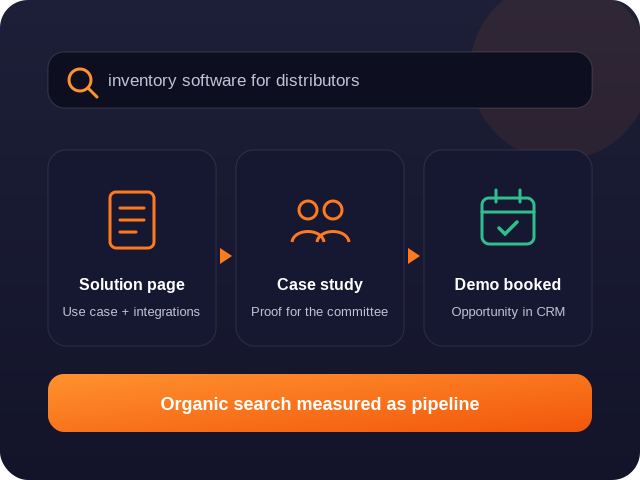
B2B buyers research for weeks before they talk to sales, often in a group and increasingly with AI assistants. We make sure your company appears at each stage of that research and that organic visits turn into demos, RFQs and qualified opportunities you can see in your CRM.
The common problem
This is what most B2B teams tell us before an audit. The cause is usually strategy, not effort:
Our B2B SEO strategy guide explains how to move from vanity traffic to high-intent pipeline.
Quick self-check
If two or more answers are “no”, there are usually clear quick wins.
Ask for a free audit →What we do
Research focused on searches that signal a project: “software for”, “vendor”, “pricing”, “alternative to”, “integration with”.
Focused pages for each problem, industry and integration, written for the people who sign off the purchase.
Honest “vs” and “alternatives” pages and pricing guidance that win buyers at the shortlist stage.
Site structure, crawlability, speed and documentation or resource hubs that rank and stay maintainable.
Expert-led articles with original insight from your team, planned around topics buyers actually research.
Citable answers, consistent entity data and third-party mentions so AI assistants include you in vendor lists.
Demo, RFQ and consultation journeys designed for each stage, from first visit to booked call.
Organic leads tracked into your CRM so you see opportunities and revenue by page and topic.
Content planning follows the model in our B2B SaaS SEO content architecture guide, built on our technical SEO and GEO service.
How it works
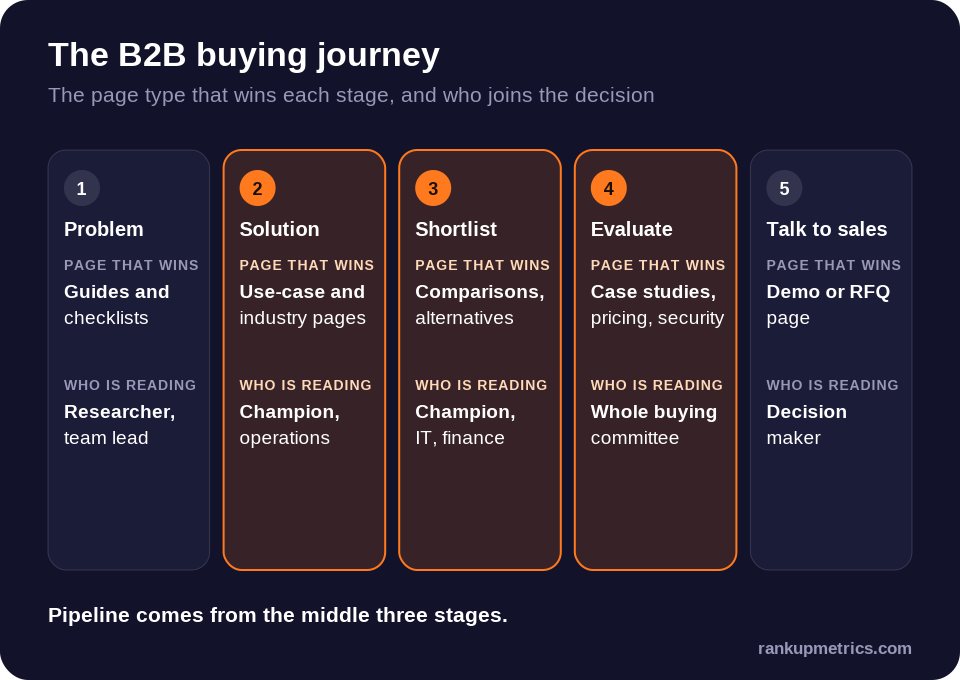
B2B buyers move through five stages, and different people join along the way. Each stage needs a different page type, and each one should lead to the next.
Who we work with
If your deals involve research, several decision-makers and a sales conversation, our approach fits. Typical clients include:
Best practices
Eight practices that decide whether B2B SEO produces pipeline.
The best keyword ideas come from calls, proposals and lost deals, not only from keyword tools.
A focused page per problem, industry or integration ranks better and converts better than one long services page.
Include the answers finance, IT, security and operations need, not only the champion’s pitch.
Fair “vs” and “alternatives” pages rank well and build trust with buyers who are already comparing.
Link case studies, integrations, certifications and results from the pages that rank, not only from a case study hub.
Early-stage readers want a guide or checklist. Late-stage readers want a demo, quote or pricing call.
Industry publications, partners and associations send more relevant links and mentions than generic link building.
Report organic opportunities and revenue by topic so budget follows what sells.
Measurement
B2B SEO often looks weak in a traffic report and strong in a pipeline report. A page that brings 40 visits a month from procurement managers can be worth far more than a blog post with 4,000 visits from students. That is why we agree on measurement before we agree on content.
We track three layers. Leading indicators show whether the strategy is working early: impressions and rankings for buyer-intent searches, and visits to solution, comparison and pricing pages. Conversion indicators show whether visitors act: demo requests, RFQs, consultation bookings and high-intent downloads, each attributed to its landing page. Business outcomes show whether it pays: opportunities created, pipeline value and closed revenue from organic leads, taken from your CRM.
Long sales cycles mean the third layer lags by months, so the first two guide decisions in the meantime. When organic leads reach the CRM with their landing page and first search topic recorded, you can see which topics produce opportunities and shift effort accordingly.
Self-reported attribution helps too. A simple “How did you hear about us?” field often reveals that buyers found you through search or an AI assistant, even when analytics credits another channel. We combine this with Search Console and GA4 reporting so you get one view of what organic search contributes.
| Layer | What we track | When it moves |
|---|---|---|
| Leading | Buyer-intent rankings, impressions, solution page visits | Weeks |
| Conversion | Demo requests, RFQs, bookings by landing page | 1 to 3 months |
| Outcome | Opportunities, pipeline value, closed revenue from organic | 3 to 9 months |
How we work
Sales interviews, CRM data, Search Console and a technical crawl to find what already works and what is missing.
A topic and page plan mapped to buying stages, with solution, use-case and comparison pages prioritised.
Expert-led pages written with your team, technical fixes and conversion paths, released by priority.
Monthly reporting on rankings, qualified leads, opportunities and revenue, connected to your CRM.
See how we build custom SEO reporting with the Search Console and GA4 APIs.
Markets we serve
We work remotely with B2B companies in the US, the UK and the UAE. In the Midwest, our Chicago B2B SEO agency focuses on manufacturers and industrial firms, and our New York SEO services support B2B, finance and professional services brands.
For manufacturers and industrial suppliers, our dedicated manufacturing SEO service applies this approach to capability pages, catalogues and RFQs. UK teams can compare our GBP plans in the UK SEO pricing guide.
Beyond SEO
Search brings buyers in, but the sales process decides whether they stay. We build B2B client portals and custom web apps that make buying and onboarding easier.
Need leads faster while SEO builds? Our B2B Google Ads management uses the same keyword and CRM data.
Frequently asked questions
B2B SEO is search optimisation for companies that sell to other businesses. It targets the searches buyers and buying committees run while researching a purchase, and measures success by qualified leads, opportunities and revenue rather than traffic alone.
B2B searches have lower volume but much higher value, sales cycles are longer, several people influence the decision, and most buyers need proof and a conversation before purchasing. B2B SEO therefore focuses on intent, depth and trust more than on volume.
Technical fixes and better conversion paths can improve leads within weeks. New solution and comparison pages typically take three to six months to rank for competitive terms. We agree milestones at the start and report against pipeline as well as rankings.
Yes. We interview your experts and use your documentation, proposals and case studies to write content that is accurate enough for specialists and clear enough for decision-makers.
Yes. We track organic leads into CRMs such as HubSpot, Salesforce or Zoho, so you can see which pages and topics produce opportunities and revenue.
Usually yes, if they are fair and accurate. Buyers comparing vendors search for these terms, and a balanced page that explains where you fit and where you do not builds trust and ranks well.
Yes. For SaaS we focus on use-case, integration, comparison and pricing pages, product-led content and documentation SEO, alongside AI search visibility.
AI assistants rely on clear, citable pages, consistent company information and mentions on trusted third-party sites such as review platforms and industry publications. We build all three as part of B2B GEO.
It depends on your market, the number of solutions and regions you target and how much content and technical work is needed. Our plans give starting points, and we confirm scope after a free audit. See SEO pricing.
Yes. We work remotely with B2B companies across the US, UK and UAE, and adapt content, currency and examples to each market.
Free B2B SEO audit
Tell us what you sell and who buys it. We’ll show you which buyer searches you are missing and what is stopping visitors from becoming leads.