Catalogue technical SEO
Crawl paths, canonical rules, pagination, faceted navigation and XML sitemaps designed so Google spends its time on pages that sell.
Online stores & product catalogues
We help online stores get their category and product pages crawled, indexed and ranking for the searches that buy, then make sure those visits turn into orders. That includes the new places shoppers search: Google’s AI results and AI shopping assistants.
The common problem
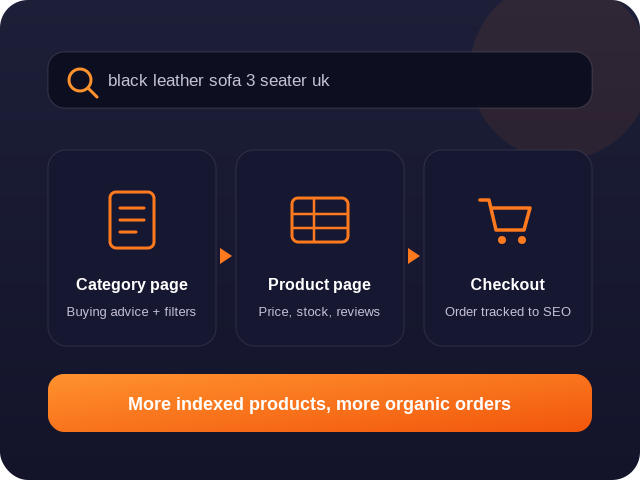
Most stores we audit do not have a traffic ceiling. They have a catalogue Google does not fully understand. The same patterns come up again and again:
Our guide to e-commerce product pages not indexing walks through the diagnosis step by step.
Quick self-check
Two or more answers pointing the wrong way usually means quick wins are available.
Ask for a free audit →What we do
Crawl paths, canonical rules, pagination, faceted navigation and XML sitemaps designed so Google spends its time on pages that sell.
Category targeting from real search data, helpful buying copy, internal links and FAQs that answer pre-purchase questions.
Unique descriptions for priority products, specifications in HTML, images with useful alt text and clear delivery and returns information.
Product, Offer, Review and Breadcrumb markup validated so listings can show price, availability and ratings.
Duplicate collection paths, tag pages, app bloat, slow themes and plugin conflicts fixed at template level.
Clear product data, comparison content and Merchant Center feeds so AI answers and shopping assistants can recommend your products.
Image, script and theme improvements aimed at Core Web Vitals on the templates that carry revenue.
Organic sessions, orders and revenue by category and product type, not just rankings.
Built on our technical SEO and GEO service. For AI shopping visibility in depth, read GEO for e-commerce.
How it works
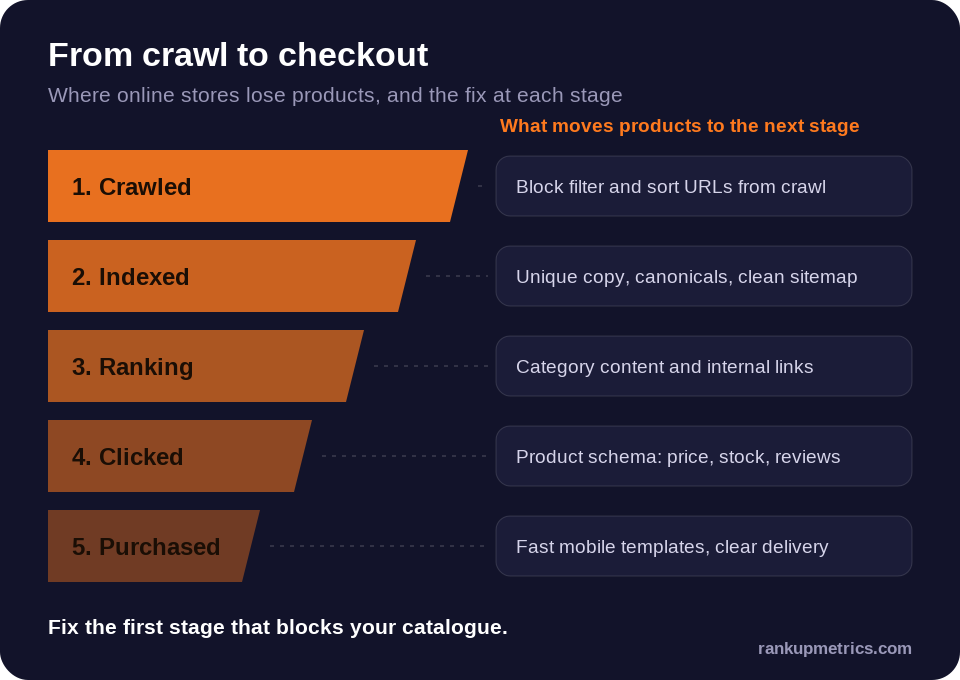
A product has to pass five stages before it earns revenue from search. We find the stage where most of your catalogue is stuck and fix that first.
Who we work with
Our approach fits any store where products, categories and search demand need to line up. Typical clients include:
Best practices
Eight practices that separate stores that grow from search from stores that stall.
A few filter combinations, such as “black leather sofas”, have real demand and deserve indexable pages. The rest should stay out of the index.
Products reachable from several collections or with tracking parameters should point to one clean, canonical URL.
Category pages usually target bigger searches than products. Give them buying advice, comparisons and links to sub-categories.
Keep temporarily unavailable products live with alternatives. Redirect permanently discontinued products to the closest match.
Sizes, materials and compatibility should be readable text on the page, not only in images or tabs that load later.
Product and Offer structured data with accurate price and availability helps both search results and AI shopping tools.
Buying guides and comparison articles should link to the categories they describe, passing relevance to the pages that sell.
Track organic orders by category and product type so you invest in the templates that pay back.
Platform detail
The principles of e-commerce SEO are the same on every platform: help search engines find the right pages, give each page a clear purpose and make buying easy. What changes is where the problems hide and how much control you have over fixing them.
Shopify handles hosting, security and basic technical SEO well, but it creates duplicate paths by design. A product can be reached at its own URL and inside every collection it belongs to, tag filters create thin pages, and apps often add scripts that slow every template. Shopify’s URL structure is also fixed, so the work focuses on canonical tags, internal links to the clean product URL, careful use of tags and filters, and theme performance.
WooCommerce gives you full control, which cuts both ways. Category and tag archives, attribute filters, pagination and plugin conflicts can generate thousands of low-value URLs, and hosting quality has a direct effect on speed. The upside is that almost anything can be fixed properly, from URL structure to structured data and caching.
Headless and custom stores give the most flexibility and the most room for error. Product pages must render their key content on the server, not only in the browser, and every SEO feature, from sitemaps to canonical tags, has to be built deliberately. If you are moving platform, plan redirects and template parity before launch using our migration checklist.
| Area | Shopify | WooCommerce |
|---|---|---|
| Duplicate URLs | Collection-based product paths and tag pages | Category, tag and attribute archives |
| Faceted navigation | Filter apps and tag filters | Filter plugins and query parameters |
| Speed | App scripts and theme code | Hosting, plugins and caching |
| Structured data | Theme-dependent, often incomplete | Plugin-dependent, can conflict |
| URL control | Fixed /products/ and /collections/ paths | Fully configurable |
How we work
Crawl, Search Console and analytics data combined to show indexing gaps, crawl waste, cannibalisation and revenue by template.
A category and filter plan, canonical and noindex rules, and internal links that match how shoppers search.
Category copy, product template improvements, structured data and speed fixes, rolled out by priority.
Monthly reporting on indexed products, rankings, organic orders and revenue, with the next priorities agreed.
Moving platform or redesigning? Follow our website migration SEO checklist before launch.
Markets we serve
We work remotely with online stores in the United States, the United Kingdom and the UAE. In Los Angeles, where many D2C brands compete nationally, our Los Angeles e-commerce SEO and GEO agency applies this approach to product discovery and AI shopping answers.
UK stores need prices in pounds, UK delivery and returns information and UK spelling across product copy. UAE stores often need English and Arabic product pages, which we set up with correct hreflang through our Arabic SEO service.
Connected systems
Product data usually lives in more than one system. We connect stores to inventory and order systems, and build custom ERP software when stock, orders and fulfilment need one source of truth.
Paid search alongside SEO? Our PPC and Meta Ads management uses the same product feed.
Frequently asked questions
E-commerce SEO is search optimisation for online stores. It focuses on getting category and product pages crawled, indexed and ranking for commercial searches, then making sure those visitors can find, trust and buy the right product.
The most common reasons are crawl budget spent on filter and parameter URLs, near-duplicate products and variants, copied manufacturer descriptions, weak internal links and products missing from the XML sitemap. An audit shows which of these applies to your store.
Yes. Most of our e-commerce work is on Shopify, Shopify Plus and WooCommerce. We also work with headless and custom-built stores, where we can fix templates directly in code.
Only the few filter combinations that match real searches and offer a useful selection of products. Everything else should be kept out of the index with canonical tags, noindex or crawl controls so Google focuses on pages that sell.
Temporarily out-of-stock products stay live with clear availability and alternatives. Permanently discontinued products are redirected to the closest replacement or category, so links and rankings are not lost.
We prioritise. Best-selling and high-margin products get unique, specification-rich descriptions first, and we improve templates so every product gains structure and useful detail. Large catalogues are improved in phases.
Accurate product data, a clean Merchant Center feed, Product structured data, reviews and helpful comparison content all help AI assistants understand and recommend your products. We cover this as part of e-commerce GEO.
Technical fixes such as indexing and crawl waste can show results within weeks. Category content and authority typically take three to six months to move competitive searches. We report progress monthly against orders and revenue.
It depends on the size of your catalogue, your platform and how much technical work is needed. Our plans give starting points, and we confirm scope after a free audit. See SEO pricing.
Usually positively. Better product data, titles and landing pages help both organic and paid shopping. We coordinate with your PPC team so feed changes do not disrupt live campaigns.
Free store SEO audit
Share your store URL. We’ll show you how many products are indexed, where crawl budget is wasted and which categories can grow fastest.