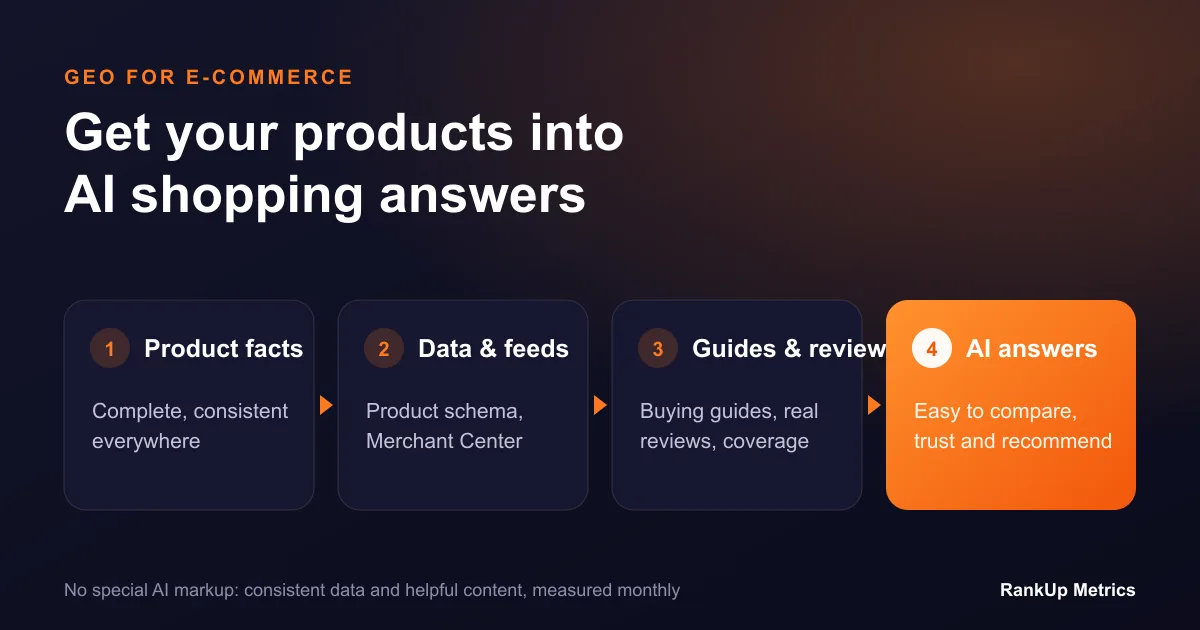
GEO for e-commerce starts with a simple scenario. A shopper asks an AI assistant for "the best lightweight carry-on for a two-week trip" and gets three recommendations with prices, sizes and a one-line reason for each. None of them is your product, even though yours fits the brief and ranks well in normal search.
This guide is for founders, e-commerce managers and marketers at direct-to-consumer and online retail brands, including the many Los Angeles brands competing nationally for the same shoppers. It explains how AI shopping answers choose products, then walks through the data, content and proof that make your store easier to recommend.
How AI Shopping Answers Choose Products
AI shopping answers in Google, and assistants such as ChatGPT, Gemini and Perplexity, draw on a mix of sources: product feeds, structured product data on web pages, merchant and product reviews, editorial content such as buying guides and comparisons, and the wider web's description of a brand.
Two consequences follow:
- Consistency matters more than ever. If your price, size or material differs between your product page, your feed and a marketplace listing, AI systems have less reason to trust any of them.
- The reasoning layer needs content. AI answers explain why a product fits. Pages that clearly state who a product is for, how it compares and what its limits are give those systems something to reference.
Google's guidance on AI features and your website is clear that there is no special markup for AI features. The foundations are normal SEO done well. GEO is about applying them with AI answers in mind.
Read more: What Is GEO (Generative Engine Optimization) and Why It Matters
Step 1: Make Product Facts Complete and Consistent
Start with an inventory of the facts a shopper or an AI system needs to compare products:
- dimensions, weight, materials and capacity
- sizes, variants and colours, with consistent naming
- price, availability and shipping times
- returns and warranty terms
- care, compatibility and use instructions
Put these facts in visible text on every product page, in the same units and wording everywhere. Then check that your feed, marketplace listings and retailer partners use the same values. Mismatched facts are one of the most common reasons a strong product is left out of comparisons.
Step 2: Add Accurate Product Structured Data
Structured data turns your product facts into a format machines can read without guessing. Follow Google's documentation for Product structured data, which covers product snippets and merchant listings, including price, availability, shipping and returns.
A few rules prevent most problems:
- Mark up only what is visible on the page.
- Keep price and availability in sync with the live page and your feed.
- Use variant markup properly for products with sizes or colours.
- Validate with the Rich Results Test after template changes, not only at launch.
Step 3: Keep Your Merchant Center Feed Clean
For Google surfaces, your Merchant Center feed is one of the main sources of product information. Free listings let products appear across Google without ad spend when the feed is approved and accurate.
Review the feed for disapproved items, missing identifiers such as GTINs where they exist, vague titles and outdated prices. Write product titles that include the attributes shoppers search for, such as brand, product type, key feature, size or colour, rather than internal product names.
Step 4: Write Buying Guides AI Systems Can Cite
AI answers need to explain why a product is a good choice. Buying guides and comparison pages give them a trustworthy page to reference, and they rank in normal search too.
Strong e-commerce guides:
- answer one specific shopping question, such as "how to choose a running shoe for flat feet"
- explain the criteria that matter, then show which products fit each need
- include honest limits, including when your product is not the right choice
- use clear headings, short paragraphs and tables for comparisons
- link to the relevant category and product pages
Avoid thin "top 10" lists that only feature your own products with no reasoning. They rarely earn citations from AI systems or trust from shoppers.
Step 5: Earn Reviews and Third-Party Proof
Reviews give AI answers the evidence they need to say a product is comfortable, durable or easy to set up. Collect reviews after genuine purchases, ask about specific attributes, show them on product pages and respond to negative ones constructively.
Beyond your own site, coverage in reputable publications, specialist reviewers and creator content shapes how AI systems describe your brand. Focus on relevant coverage rather than volume.
Step 6: Fix the Technical Basics on Product Pages
GEO still depends on search engines being able to crawl and understand your store:
- keep product and category pages fast on mobile, especially image-heavy templates
- make sure headless or JavaScript-heavy builds render product content, prices and links for search engines
- control faceted navigation so valuable filter pages are indexable and endless combinations are not
- redirect discontinued products to the closest alternative or category, not the homepage
Read more: Core Web Vitals: How to Improve LCP, INP and CLS
How to Measure GEO for E-commerce
AI answer visibility is still hard to measure precisely, so combine several signals:
- Organic revenue and orders by category and product, from analytics.
- Search Console impressions and clicks for product and category pages, including long, conversational queries.
- Manual AI checks: a fixed set of shopping questions asked monthly in the main assistants, recording whether your brand appears and how it is described.
- Referral traffic from AI assistants where it is reported in analytics.
No one can guarantee placement in AI answers. The goal is to make your products the easiest, most trustworthy option to recommend.
Example: A Product Page Before and After GEO Work
Here is how a typical direct-to-consumer product page changes when it is improved for both search and AI shopping answers:
| Element | Before | After |
|---|---|---|
| Title | "The Voyager" | "The Voyager Carry-On Suitcase, 22 x 14 x 9 in, 7.1 lb" |
| Description | Brand story and lifestyle copy | Who it is for, key specs, what makes it different, and when another model fits better |
| Specifications | In an image | Visible text table with dimensions, weight, materials, warranty |
| Structured data | Name and price only | Product, offers, shipping, returns and review data matching the page |
| Feed | Internal name, outdated price | Descriptive title, current price, GTIN, consistent variants |
| Reviews | Star rating only | Reviews that mention fit, durability and use cases |
| Related content | None | Link to a buying guide on choosing carry-on luggage |
None of these changes is exotic. Together, they make the product easy to compare, easy to trust and easy to describe accurately.
A Monthly GEO Checklist for E-commerce Teams
- Ask a fixed list of 10–20 shopping questions in the main AI assistants and record which brands appear and how yours is described.
- Check Merchant Center for new disapprovals, missing attributes and price mismatches.
- Validate structured data on your top product and category templates.
- Compare product facts across your site, feed and main marketplaces for your top sellers.
- Review new customer reviews for recurring themes, and answer common questions on product pages.
- Update or add one buying guide based on the questions customers ask most.
- Check Search Console for new long, conversational queries reaching product and guide pages.
Frequently Asked Questions About GEO for E-commerce
Is GEO different from e-commerce SEO?
GEO builds on e-commerce SEO rather than replacing it. The same foundations, such as crawlable pages, accurate product data and helpful content, serve both. GEO adds emphasis on consistency, comparison-ready facts and content that explains why a product fits a need.
Do I need special markup for AI shopping answers?
No special AI markup is required. Use standard Product structured data and a clean Merchant Center feed, and keep both consistent with your visible product pages.
Does selling on marketplaces help or hurt?
Marketplaces can add visibility, but inconsistent titles, prices or specifications across channels make your products harder to trust. Keep core product facts aligned everywhere you sell.
How quickly can GEO work show results?
Feed and data fixes can affect Google surfaces relatively quickly, while content and reputation work builds over months. Track progress monthly rather than expecting a single switch to flip.
Bringing It Together
GEO for e-commerce is not a separate channel. It is product data, structured data, feeds, honest content and real reviews, all kept consistent, so that both search engines and AI assistants can understand and recommend what you sell.
We run e-commerce SEO and GEO for brands nationally and in Southern California. See our e-commerce SEO and GEO services in Los Angeles, or contact us for a free review of how AI assistants currently describe your products.