AI visibility baseline
We test the questions your buyers ask across AI tools and record where you are mentioned, cited or missing.
Generative engine optimization
Buyers now ask Google’s AI results, ChatGPT, Perplexity and Copilot which provider to choose. We help your business appear in those answers: by making your pages easy for AI systems to understand and quote, strengthening how your brand is described across the web, and measuring the visibility and enquiries that follow.
The common problem
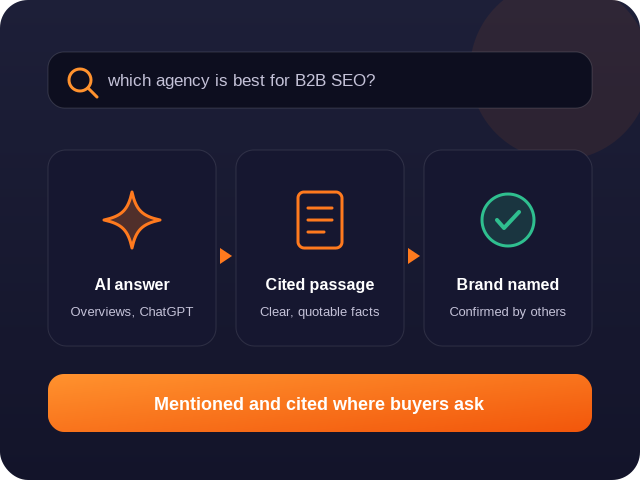
AI answers choose sources differently from a list of ten blue links. Businesses that are invisible in them usually share a few gaps:
New to the topic? Start with what GEO is and why it matters.
Quick self-check
If the answer to the first question is “no”, the other three usually explain why.
Ask for a free audit →What we do
We test the questions your buyers ask across AI tools and record where you are mentioned, cited or missing.
Clear definitions, steps, comparisons, prices and FAQs written in short, self-contained passages AI systems can quote.
One consistent description of your company, services and locations across your site, profiles and directories.
Organization, Service, Product, FAQ and Article markup that tells machines exactly what each page represents.
Robots rules, rendering and site speed checked so search and AI crawlers can read your important pages.
Reviews, comparisons, industry articles and partner mentions that AI systems treat as independent evidence.
First-hand data, examples and expert commentary that make your pages worth citing over generic content.
Mentions and citations tracked over time, alongside AI referral traffic and enquiries in analytics.
GEO works on top of strong SEO, not instead of it. See our technical SEO and GEO service and our guide to improving AI search visibility.
How it works
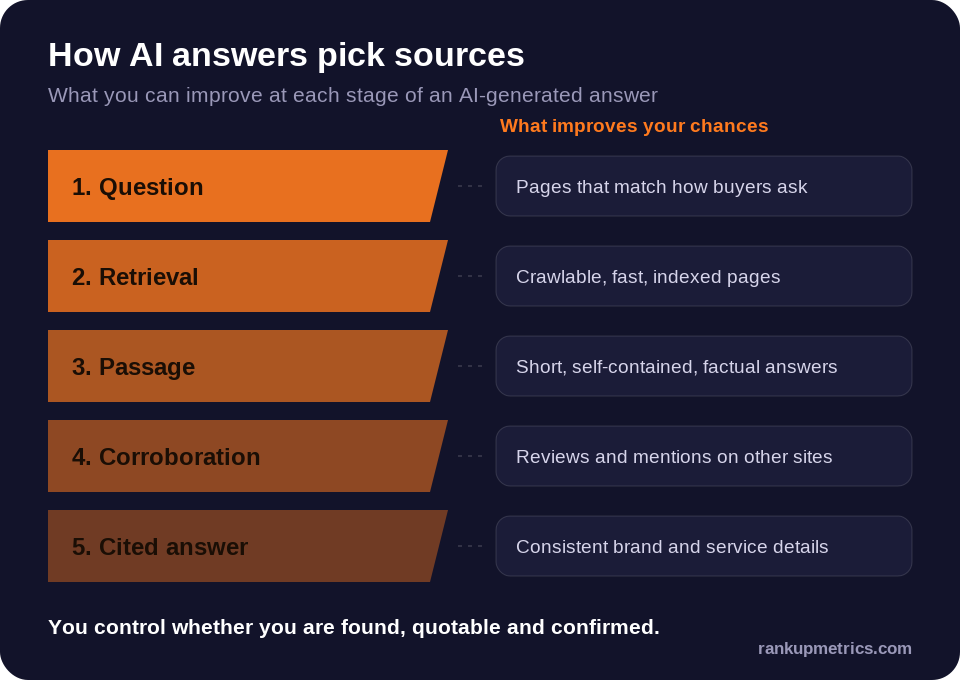
AI search tools find candidate pages, pick the passages that answer the question, check them against other sources and then write an answer. Each stage has its own requirements.
Who we work with
AI answers matter most where buyers compare providers or products before contacting anyone. Typical clients include:
Best practices
Eight practices that make a website easier for AI systems to understand and cite.
Open each section with a direct, complete answer, then add detail. AI systems favour passages that stand on their own.
Headings phrased like the questions buyers ask make it easier to retrieve the right passage.
Prices, timelines, coverage, specifications and named processes are quotable. “Leading provider” is not.
Use the same company name, services, locations and descriptions everywhere your business appears.
Reviews, comparisons and articles on other sites carry weight that your own pages cannot.
Schema should describe visible content accurately. It helps machines, but only when it is true.
Original data, examples and named experts give AI systems a reason to cite you rather than a summary site.
Update dates, prices and facts regularly. Stale information is less likely to be used.
GEO vs SEO
GEO is not a replacement for SEO. Most AI search tools find information by searching the web, so pages that are crawlable, indexed, fast and trusted remain the starting point. A site with technical problems or thin content is no more likely to be cited by an AI tool than it is to rank on Google.
What changes is how the result is used. A traditional search result sends the visitor to your page to read it. An AI answer reads the page for the visitor, takes one or two passages and combines them with other sources. That rewards pages that answer questions directly, state facts clearly and are confirmed by independent sources. It also means a visitor may learn about you without clicking, so brand mentions and accurate descriptions matter alongside traffic.
Measurement changes as well. Rankings are stable and easy to track; AI answers vary by wording, location and time. We therefore track a fixed set of buyer questions over time and look for trends in mentions and citations, rather than treating one answer as a ranking.
For most businesses the practical plan is the same: fix technical foundations, make key pages clearer and more factual, keep your company information consistent and earn genuine third-party mentions. Our article on AI search visibility explains this for larger brands.
| Area | Traditional SEO | GEO / AI search |
|---|---|---|
| Goal | Rank pages in search results | Be mentioned and cited in AI answers |
| Unit of success | Whole page | Individual passage and brand mention |
| Key signals | Relevance, links, technical health | Plus clarity, facts and corroboration |
| Measurement | Rankings, clicks | Mentions, citations, AI referrals |
How we work
We test your buyers’ key questions across AI tools and audit crawler access, structured data and entity consistency.
A plan covering the pages to restructure, facts to publish, profiles to fix and third-party sources to pursue.
Content restructuring, new answer-focused pages, schema, technical fixes and authority building, by priority.
Monthly re-testing of the same questions, plus AI referral traffic and enquiries from analytics.
For online stores, our GEO for e-commerce guide covers AI shopping answers and product data.
Markets we serve
We run GEO alongside SEO for businesses in the US, UK, UAE and Saudi Arabia. Our Miami SEO agency combines local, bilingual and AI search, and our Los Angeles e-commerce SEO and GEO agency focuses on AI shopping answers.
For B2B companies, GEO is part of our B2B SEO services, because buyers increasingly ask AI tools to shortlist vendors. Arabic-speaking markets are covered through our Arabic SEO service.
AI inside your business
GEO helps AI find you. Our AI integration and automation team helps you use AI internally, from CRM workflows to assistants that answer customers.
Read how we connect AI to CRM and ERP systems.
Frequently asked questions
GEO is the practice of improving how often and how accurately a business is mentioned and cited in answers generated by AI search tools, such as Google AI Overviews and AI Mode, ChatGPT, Perplexity and Microsoft Copilot.
GEO builds on SEO. AI search tools still rely on crawlable, trustworthy pages, so technical SEO and quality content remain the foundation. GEO adds a focus on quotable passages, entity consistency, third-party mentions and measuring visibility inside AI answers.
No one can guarantee placement, because AI systems generate answers dynamically and change often. What we can do is remove the barriers that keep you out and strengthen the signals AI tools use, then measure the change against a baseline.
We test a fixed set of buyer questions across AI tools each month and record mentions, citations and the competitors named. We combine this with AI referral traffic and enquiries from your analytics.
It helps machines understand what a page represents, which supports both search results and AI systems. It works best when it accurately reflects visible content and is combined with clear, well-structured pages.
That is a business decision. Blocking some crawlers can reduce how often AI tools use your content. We explain the trade-offs for each crawler and set robots rules that match your goals.
llms.txt is an optional file that summarises a site for AI tools. It is not used by Google Search, but it is quick to add and can help some assistants. We treat it as a small extra, not a core tactic.
Technical and content changes can be picked up within weeks by tools that search the live web. Changes in how models describe your brand generally take longer and depend on third-party mentions.
GEO is included in our Advanced SEO plan and can be added to other plans. Scope depends on the number of services, markets and questions tracked. See SEO pricing.
We focus on Google AI Overviews and AI Mode, ChatGPT search, Perplexity, Microsoft Copilot and Gemini, prioritised by where your buyers actually search.
Free AI visibility audit
Tell us your services and markets. We’ll test the questions your buyers ask AI tools and show you where you appear, where competitors do, and why.