
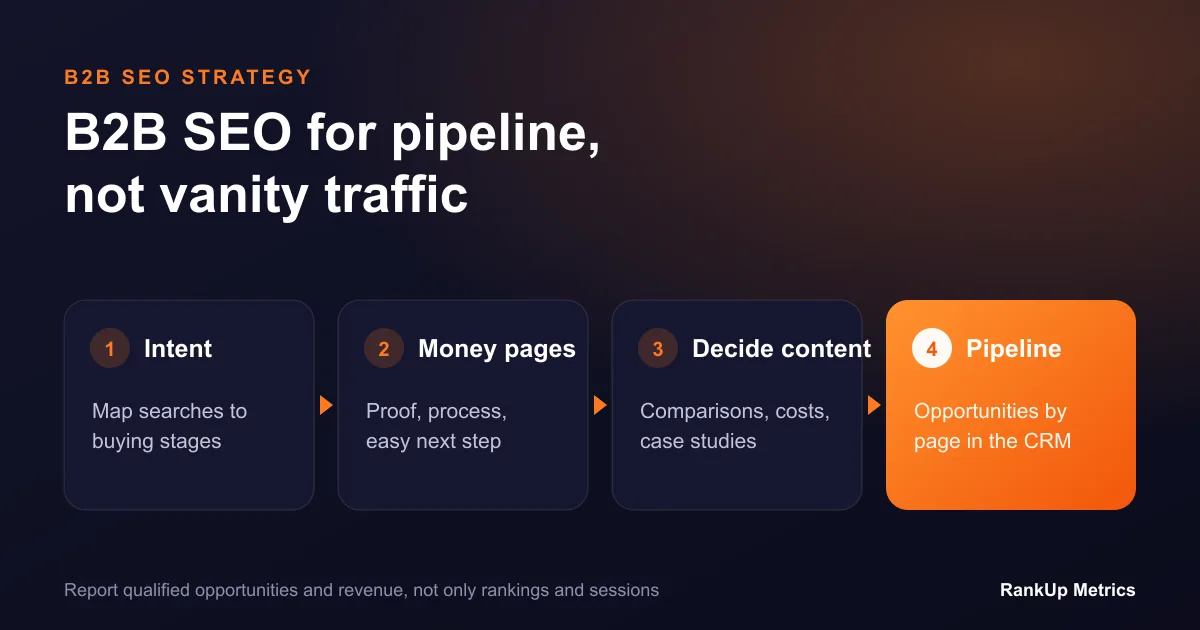
Many B2B companies have an SEO report that looks great and a sales team that has never seen an SEO lead. Traffic is up, rankings are up, and pipeline is flat. The problem is rarely effort. It is targeting: the content attracts readers, not buyers.
This guide sets out a B2B SEO strategy built for high-intent pipeline. It is for marketing leaders, founders and sales leaders at B2B service, software and industrial companies who want search to produce qualified opportunities.
Why B2B SEO Often Produces Vanity Traffic
- Top-of-funnel bias. "What is" articles are easy to rank and drive traffic, but most readers are students, job seekers or competitors.
- Weak commercial pages. Service and product pages are thin, generic or buried, so buyers who do arrive leave.
- No CRM link. Reports stop at form fills, so no one knows which pages create real opportunities.
- Volume-led keyword choice. High-volume terms win budgets even when low-volume, high-intent terms are worth far more.
Step 1: Map Searches to the Buying Journey
Group your keywords by what the searcher is trying to do:
| Stage | Example searches | Page type |
|---|---|---|
| Problem aware | "why is our ERP so slow", "manufacturing website no RFQs" | Diagnostic guides |
| Solution aware | "custom ERP vs off the shelf", "client portal for distributors" | Comparisons, use-case pages |
| Vendor selection | "ERP development company UK", "B2B SEO agency Chicago" | Service and location pages |
| Decision | "custom ERP cost", "SEO agency pricing" | Pricing, case studies, process pages |
Prioritise the bottom two rows first. They have lower search volume, but a much higher share of buyers. Then build problem and solution content that links into them.
Step 2: Make Commercial Pages Worth Ranking
Service pages are where B2B SEO earns its money. A strong one:
- names the service, the buyer and the problem in plain language;
- explains the process, timeline and what the client receives;
- shows proof: case studies, named clients where allowed, results, certifications;
- answers objections about price, risk, contracts and switching;
- makes the next step easy, such as a short form, a calendar link or a direct contact.
Build one focused page per service and, where you genuinely serve them, per industry and location. One "Services" page cannot rank for everything.
Step 3: Create Content That Buyers Use to Decide
The most valuable B2B content helps buyers make a decision:
- comparisons between approaches, such as build vs buy;
- pricing and cost guides that explain what drives cost, even if you do not publish fixed prices;
- implementation guides that show how the work is done and what can go wrong;
- case studies with the problem, the approach and the measured result;
- checklists and templates buyers can use with their team.
Every piece should link to the commercial page it supports, and every commercial page should link to its supporting content. This hub-and-spoke structure is explained in our guide to B2B SEO content architecture.
Step 4: Earn Trust in Google and AI Search
B2B buyers increasingly ask AI assistants for vendor shortlists and comparisons. The signals that help you appear there are the same ones that help in Google:
- clear, factual pages about what you do, for whom and where;
- named experts with real credentials on your content;
- consistent company information across your site, directories and profiles;
- third-party mentions: reviews, directories, partner pages, articles and podcasts;
- structured data for your organisation, services and articles.
Read more in our guide to generative engine optimisation.
Step 5: Measure Pipeline, Not Traffic
Connect SEO to the CRM:
- Capture the landing page and source on every form and call.
- Pass them into the CRM with the lead.
- Report monthly on organic leads, qualified opportunities, pipeline value and closed revenue by page group.
- Track assisted conversions, since many B2B buyers visit several times before they get in touch.
Then reallocate effort to the page groups that produce pipeline. That single loop changes what a B2B SEO programme focuses on.
A 90-Day Starting Plan
- Weeks 1 to 3: audit commercial pages, set up CRM tracking, map keywords by buying stage.
- Weeks 4 to 8: rebuild the top five commercial pages, fix technical issues on them, add proof.
- Weeks 9 to 12: publish the first decision-stage content and connect it to those pages, then review the first pipeline data.
Next Steps
Our SEO and search optimisation services are built around pipeline reporting, and our Chicago B2B SEO agency and New York SEO agency teams apply this approach for US B2B firms. For manufacturers, see our manufacturing SEO services.