
The analytics dashboard says the site gets steady traffic. Sales says the website produces almost nothing. Both are right. On most industrial sites we audit, the visitors are real, but they are the wrong visitors, arriving on the wrong pages, with no easy way to ask for a quote.
This guide is for marketing managers, sales leads and owners at manufacturers, job shops and industrial suppliers whose manufacturing website gets traffic but very few RFQs. It explains how to diagnose the problem in an afternoon, nine fixes that consistently increase quote requests, and how to decide who should handle the work.
First, Diagnose Where the Leak Is
Before changing anything, find out which of three problems you have. Most sites have more than one.
1. The traffic is not commercial. Open Search Console, go to Performance, and sort queries by clicks. If the top queries are definitions, careers, students' questions or your own brand name, the traffic was never going to request a quote.
2. The right visitors land on the wrong pages. Check which pages get the clicks. If blog posts and the homepage take most of the traffic while capability pages get very little, buyers are not finding the pages that sell.
3. Buyers arrive but cannot or will not convert. Look at the RFQ page in analytics. Many visits with few submissions usually means the form, the information on the page or the trust signals are the problem.
Write down which problems apply. The fixes below are grouped so you can start with the one that matters most.
Fixes for Targeting: Attract Buyers, Not Browsers
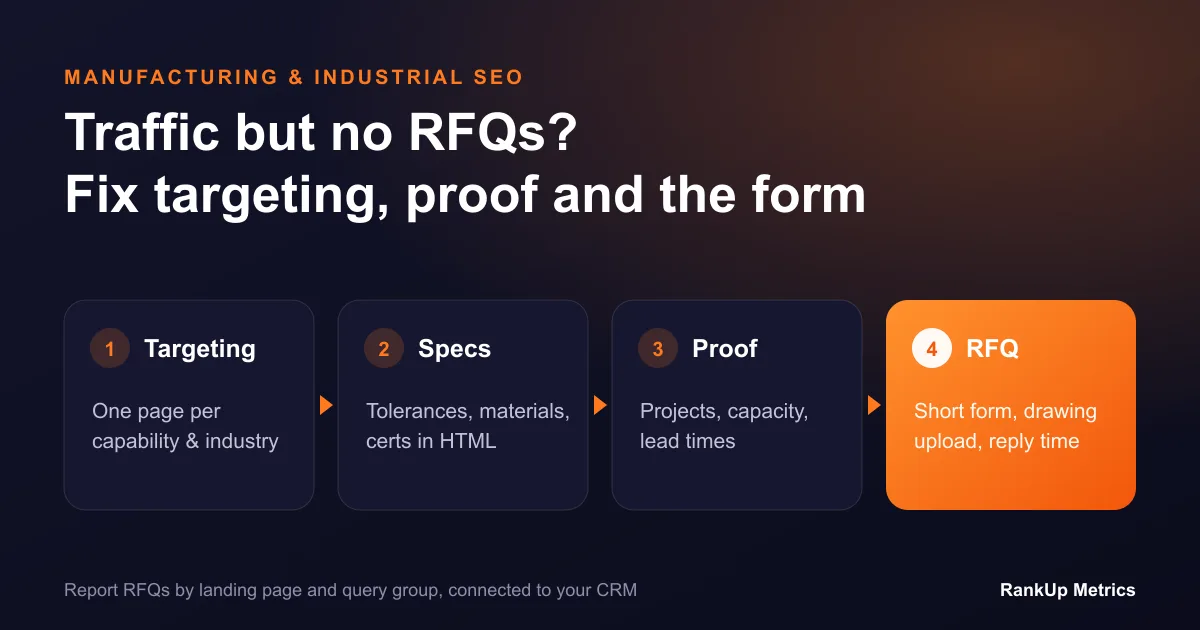
1. Build one page per capability
A single "Services" page cannot rank for CNC milling, sheet-metal fabrication and powder coating at the same time. Give each process, material and service its own focused page that names the capability the way engineers search for it.
2. Add application and industry pages
Engineers often search by problem or application, such as "machined components for medical devices" or "corrosion-resistant fasteners for marine use". Industry and application pages capture searches that capability pages miss, and they show buyers you understand their sector.
3. Put specifications in HTML, not only in PDFs
Tolerances, sizes, materials, finishes and certifications should be readable text on the page. Keep the datasheet as a download, but do not make the PDF the only place the information exists. Search engines and buyers both read HTML more easily.
Read more: B2B SEO Content Architecture for SaaS and Industrial Sites
Fixes for the Page: Answer the Buyer's Checklist
4. Show the proof buyers look for
Procurement teams check certifications, capacity, lead times, industries served, equipment lists and quality processes before they shortlist a supplier. Make these visible on capability pages instead of hiding them on an "About" page. Only list certifications you actually hold.
5. Use real project examples
Short project summaries with the part type, material, tolerance, quantity and industry are more persuasive than generic claims. Use photos of real parts and facilities rather than stock images. If clients are confidential, describe the project without naming them.
6. Fix speed and crawlability on large catalogues
Large product or part catalogues often generate thousands of near-duplicate filter URLs, which wastes crawling and dilutes rankings. Google's guidance on managing faceted navigation explains how to keep valuable pages indexable without letting endless combinations through. Check page speed on mobile too, because buyers often research on phones before they sit down to request a quote.
Fixes for the RFQ: Remove Friction
7. Shorten the quote form
Long forms with mandatory fields for budget, annual volume and job title lose buyers who are still early in research. Ask for the minimum needed to respond: name, company, email, a short description and an optional drawing upload. Collect the rest in your reply.
8. Allow drawing uploads and set expectations
Let buyers attach STEP, DXF or PDF drawings, and say what happens next and when: "We reply within one business day with questions or a quote." Uncertainty about response time is a common reason buyers leave.
9. Put the RFQ on every commercial page
The quote request should be visible near the top and again after key sections on every capability and industry page, not only in the main navigation. Track submissions per page so you know which pages produce real opportunities.
Measure RFQs, Not Just Traffic
Once the fixes are live, change what you report. Track RFQs and qualified enquiries by landing page and by query group, and connect them to your CRM where possible. A page with modest traffic and steady RFQs is worth more than a popular blog post that never converts.
Our guide to custom SEO reporting with the Search Console and GA4 APIs shows how to build that view.
Who Should Handle Technical SEO for B2B Manufacturers?
Manufacturers usually choose between four options:
| Option | Best for | Watch out for |
|---|---|---|
| In-house marketer | Small sites with a technical team nearby | Limited time and technical SEO depth |
| Web design agency | Rebuilds and design refreshes | Launching a new site without SEO migration planning |
| General SEO agency | Broad visibility work | Little understanding of engineering buyers or RFQ journeys |
| Industrial SEO specialist | Capability pages, catalogues and RFQ conversion | Check they can show relevant work and explain their process |
For most manufacturers, the right answer is a specialist who works closely with your engineers and sales team, because the best capability content comes from the people who know the process.
Example: Turning One Capability Into a Page That Converts
Take a contract manufacturer whose five-axis CNC machining is buried in a bullet list on the "Services" page. A converting capability page would include, in this order:
- A specific headline and summary: "5-Axis CNC Machining for Aerospace and Medical Components", with materials, typical part sizes and tolerances in the first paragraph.
- An RFQ button and drawing upload visible without scrolling.
- Capabilities table: machines, work envelope, materials, achievable tolerances, finishes and quantities from prototype to production.
- Industries and applications: short sections linking to aerospace and medical industry pages.
- Quality and certifications: inspection equipment, quality system and the certifications actually held.
- Two or three project summaries: part, material, challenge, result, with real photos.
- FAQs from sales calls: lead times, minimum order quantities, file formats, NDAs.
- A second RFQ prompt with a stated response time.
Each element answers a question a buyer would otherwise email about, or leave to ask a competitor.
A Quick RFQ Audit You Can Run This Week
- Submit your own RFQ form on a phone and time how long it takes.
- Count the mandatory fields and remove any you can collect later.
- Check that the form accepts the file types your buyers actually send.
- Confirm that form submissions reach a monitored inbox and the CRM.
- Open your top five capability pages and check that an RFQ prompt is visible without scrolling.
- Compare Search Console's top queries with your capability list, and note any capability with no page.
- Ask sales for the ten questions buyers ask most, and check whether your site answers them.
Most manufacturers find at least three quick fixes in this audit alone.
Frequently Asked Questions
How long does it take to see more RFQs after these changes?
Form and page fixes can increase RFQs within weeks, because they convert traffic you already have. New capability and application pages usually need a few months to rank.
Should industrial websites still have a blog?
Yes, if posts answer real engineering and buying questions and link to the relevant capability pages. A blog full of company news rarely brings buyers.
Is PPC better than SEO for manufacturers?
They do different jobs. PPC can bring RFQs quickly for high-intent terms, while SEO builds lasting visibility for the long list of capability, material and application searches. Many manufacturers use PPC to test which terms convert, then invest in SEO for those terms.
Do we need to show prices on our website?
Most manufacturers quote per job, which is fine. Explain what affects the price, typical minimum quantities and how quickly you respond, so buyers know what to expect.
Bringing It Together
When a manufacturing website gets traffic but no RFQs, the fix is rarely "more traffic". It is attracting the searches that buyers make, giving them the specifications and proof they need on the page, and removing friction from the quote request.
We help manufacturers and industrial suppliers do exactly this through our manufacturing and industrial SEO services. For Midwest firms, our manufacturing SEO in Chicago service adds local and regional visibility. Ask for a free audit and we will show you where your RFQs are leaking.