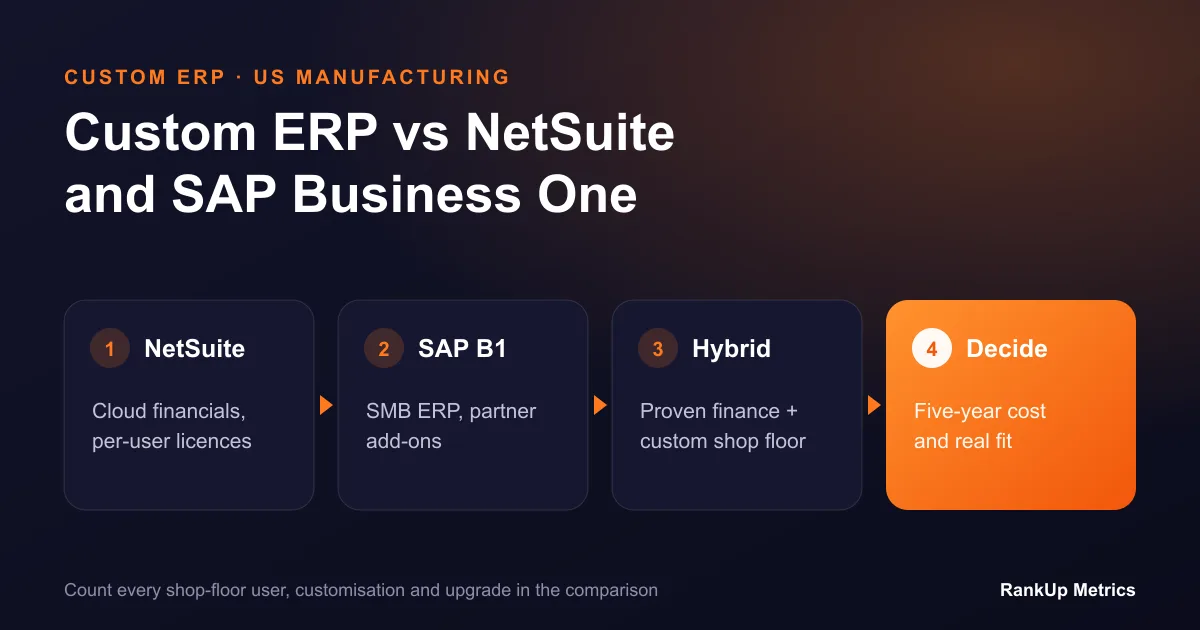
When a US manufacturer outgrows QuickBooks and spreadsheets, the shortlist usually starts with NetSuite and SAP Business One. Both are capable, widely used and well supported. But mid-sized manufacturers with distinctive processes often find themselves paying for seats, modules and consultants to make the software behave like their plant.
This guide compares a custom ERP with NetSuite and SAP Business One for mid-sized US manufacturers, and explains when a hybrid approach makes more sense than either extreme.
What NetSuite and SAP Business One Do Well
NetSuite is a cloud ERP with strong financials, multi-entity consolidation, a large partner ecosystem and good e-commerce and CRM options. It suits growing companies that want one vendor and standard processes.
SAP Business One is aimed at small and mid-sized businesses, with solid inventory, purchasing and production features, and many industry add-ons from partners. It can be hosted on-premises or in the cloud.
Both are sensible choices when your processes are close to what the software expects and you value a single supported platform.
Where Manufacturers Run Into Limits
- Shop-floor reality. Routings, work centres, rework, subcontracting and quality checks rarely match the standard model exactly.
- Per-user licences. Production supervisors, warehouse staff and quality inspectors need a few screens, but may need full or limited licences.
- Customisation cost. Scripts, add-ons and partner customisations add cost upfront and at every upgrade.
- Integration with machines and MES. Connecting to machine data, scales, label printers and existing MES systems often needs custom work anyway.
- Configure-to-order and quoting. Complex product configurations and quoting rules are frequently handled outside the ERP in spreadsheets.
Comparison for a Mid-Sized Manufacturer
| Factor | NetSuite | SAP Business One | Custom ERP |
|---|---|---|---|
| Financials and consolidation | Strong | Good | Usually integrated with an existing accounting system |
| Production fit | Standard, add-ons available | Standard, many partner add-ons | Built around your routings and rules |
| Shop-floor users | Licence per user | Licence per user | Typically no per-seat fees |
| Customisation | SuiteScript, partners | SDK, partners | Unlimited, by design |
| Upgrades | Vendor-managed releases | Version upgrades with partners | You control timing |
| Time to first value | Moderate | Moderate | Phased; first module in a few months |
| Vendor dependency | High | High, plus partner | Depends on code ownership terms |
The Hybrid Option Many Manufacturers Choose
You do not have to choose one system for everything. A common pattern:
- keep financials in a proven accounting system or ERP core;
- build custom modules for production scheduling, shop-floor data capture, quality and quoting;
- integrate them through APIs so finance, inventory and production stay in sync.
This avoids rebuilding accounting, keeps licences for the finance team only, and gives the plant floor software that fits how it works.
Total Cost Over Five Years
Compare like for like over five years, including:
- licence or subscription fees for every user who needs access, at your expected headcount;
- implementation partner fees, customisations and add-ons;
- rework of customisations after upgrades;
- integration with machines, e-commerce, EDI and CRM;
- build, hosting and support costs for custom modules;
- staff time lost to workarounds in each scenario.
The answer varies a lot by company. A 40-person job shop with standard processes may be best served by a packaged ERP. A 250-person manufacturer with complex routings and 120 shop-floor users may find a custom or hybrid approach costs less and fits better.
Questions to Settle Before Choosing
- Which of our processes give us a competitive advantage, and must the system support them exactly?
- How many users need access, and which of them need only a few screens?
- What will we have to integrate, and does each option support it natively?
- Who will own the customisations, code and data?
- What happens to our customisations at the next major upgrade?
Next Steps
Our custom ERP development team helps US manufacturers compare packaged, hybrid and custom options with a fixed-scope discovery, and our Chicago web development team works with Midwest manufacturers directly. For the general decision framework, read custom ERP vs off-the-shelf ERP, and for budgets see custom ERP development cost.