Walk into many UK manufacturers or distribution businesses and you will find a familiar setup: an old green-screen or Access-based system that only two people fully understand, an accounting package, and spreadsheets doing the rest. It works, until a key person leaves, a customer asks for real-time stock data, or the old server finally fails.
This guide is for owners, operations directors and finance leads at UK logistics and manufacturing firms considering bespoke ERP software. It covers the UK-specific requirements, where custom systems pay off, and how to migrate without disrupting operations.
Why UK Firms Are Replacing Legacy Systems Now
- Key-person risk. The system depends on people close to retirement, or on a supplier that no longer exists.
- Customer expectations. Larger customers expect EDI, portals, live stock and accurate delivery dates.
- Tax and compliance. Making Tax Digital requires VAT records to be kept digitally and submitted through compatible software, and manual workarounds add risk.
- Security. Unsupported operating systems and databases are a growing cyber risk, and some customers now ask suppliers about it.
- Labour costs. Manual re-keying between systems is expensive when skilled staff are hard to find.
Requirements Specific to UK Operations
VAT and Making Tax Digital. The ERP should keep digital VAT records and either submit returns through HMRC-recognised software or pass clean data to your accounting package that does. Since April 2022, Making Tax Digital for VAT applies to all VAT-registered businesses.
Customs and trade data. If you import or export, especially to and from the EU, you need commodity codes, country of origin, incoterms and customs values held against products and shipments.
Carrier integrations. Connections to UK carriers and couriers for labels, tracking and proof of delivery remove a lot of manual work.
Units, pricing and contracts. Customer-specific price lists, rebates and contract pricing are common in UK B2B supply and often poorly handled by older systems.
Data protection. Customer and employee data must meet UK GDPR requirements, including access controls and retention rules.
Where a Bespoke ERP Pays Off
Multi-warehouse inventory. Real-time stock by location, bin and batch, with barcode scanning on handheld devices, instead of end-of-day spreadsheet updates.
Production planning. Bills of materials, routings and capacity planning that reflect how your shop floor actually works, including subcontracted operations.
Supply chain automation. Reorder suggestions based on demand and lead times, supplier portals for confirmations and automatic updates of expected delivery dates.
Traceability. Batch and serial tracking from supplier to customer, essential for food, aerospace, automotive and medical supply chains.
Customer visibility. Order tracking and documents through a B2B client portal, reducing calls and emails.
A Low-Risk Migration Plan
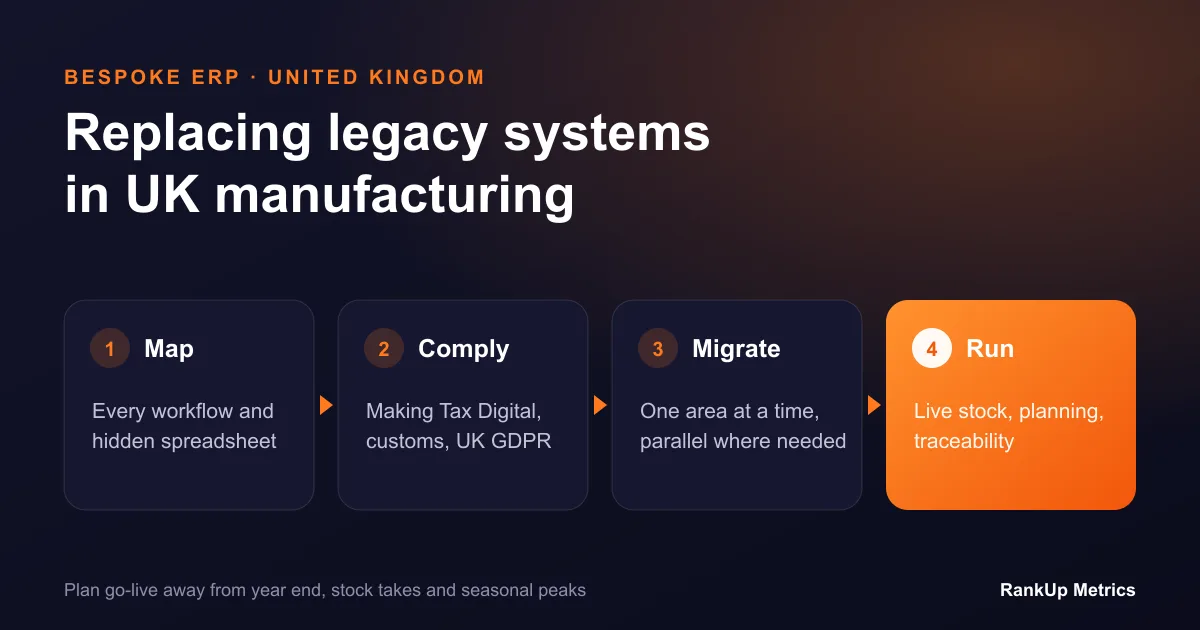
1. Map before you build. Document every workflow, report and integration in the legacy system, including the unofficial spreadsheets. Ask the people who use it, not only managers.
2. Run in parallel where it matters. For stock and finance, run the old and new systems together for a short period and compare results before switching off the old one.
3. Migrate in phases. Move one area at a time, such as purchasing, then inventory, then production. Each phase goes live on its own.
4. Clean the data first. Remove duplicates, standardise product codes and close old records before the move. Test the migration several times.
5. Train with real scenarios. Use your own orders and products in training, not generic demo data.
6. Plan go-live outside peak periods. Avoid year-end, stock takes and seasonal peaks.
What It Costs and How Long It Takes
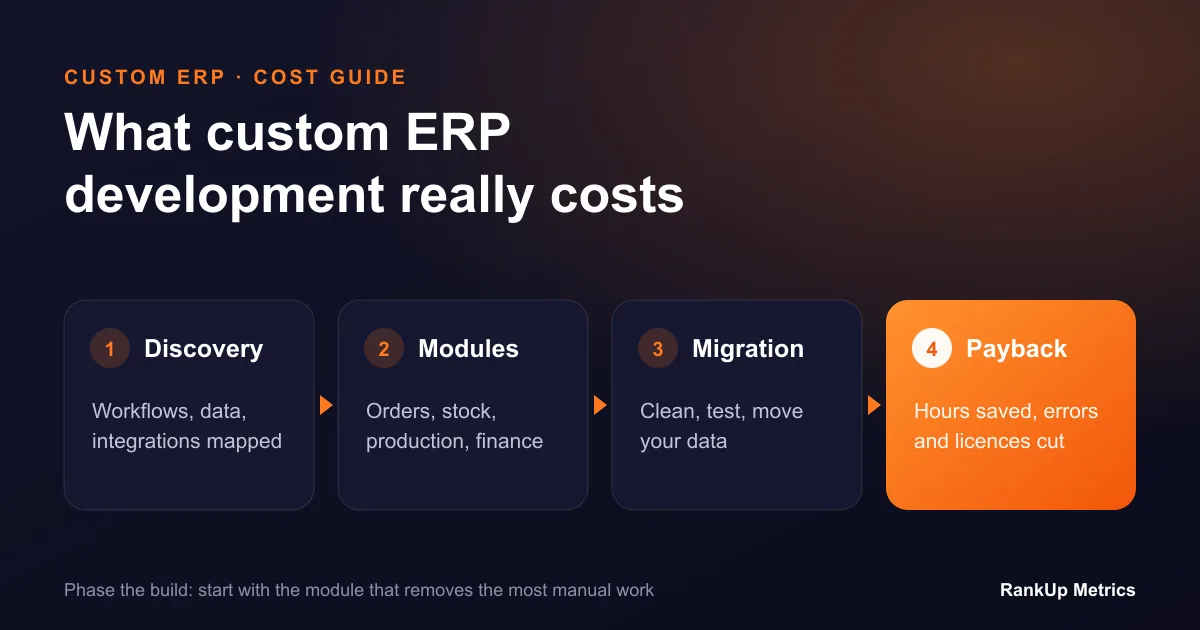
A focused first phase, such as inventory and purchasing with a link to your accounting package, typically takes three to five months. A full replacement with production, portals and several integrations is usually phased over 9 to 18 months. Our custom ERP development cost guide explains the cost drivers module by module.
Next Steps
We build bespoke ERP systems for UK manufacturers and distributors, with discovery workshops that map your legacy system before any code is written. See our custom ERP development services, or work with our Birmingham web development team and Manchester web development team.