
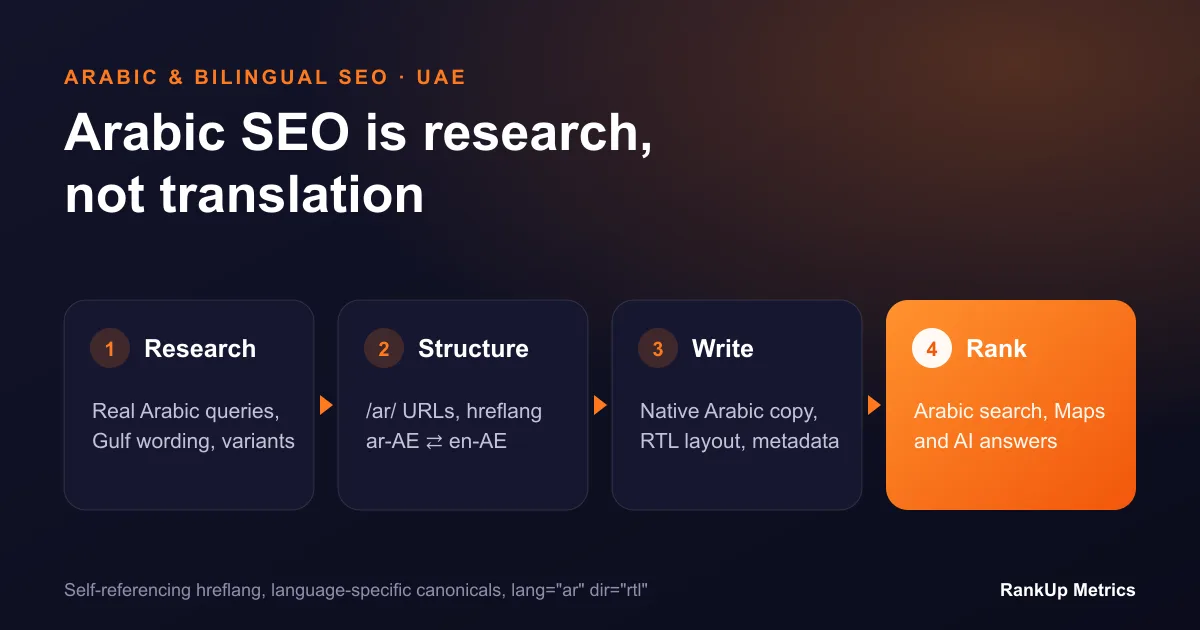
Many UAE websites have an Arabic version that nobody finds. The pages exist and the translation is technically correct, yet almost all organic traffic still lands on the English site. Arabic SEO fixes the real cause: the Arabic pages were translated rather than researched, written and set up for Arabic search.
This guide is for marketing teams and business owners in Dubai and across the UAE who want their Arabic pages to rank and convert, not just exist. It covers how Arabic search differs from English, how to research Arabic keywords, the technical setup Google needs, and the most common bilingual mistakes we see.
Why Arabic SEO Is Not Translation
Arabic SEO starts from a simple fact: people do not search in the same words a translator would choose. A few differences explain most of the gap.
Formal and everyday Arabic differ. Pages are usually written in Modern Standard Arabic, but many searches use Gulf wording or shorter everyday phrases. The best pages read naturally in standard Arabic while still including the terms people type.
Spelling varies. Arabic searchers mix forms such as أ, إ and ا, or ة and ه at the end of words. Search engines handle many variants, but your research should capture which forms carry real demand.
Some people search in Arabizi or English. Arabic speakers often switch to English for technical or brand terms, and some use Latin letters for Arabic words. Your Arabic pages should not avoid an English brand or product name that customers actually use.
Competition is often lower. In many UAE sectors, fewer businesses invest seriously in Arabic content. That makes well-built Arabic pages one of the more efficient opportunities in local search.
How to Research Arabic Keywords
Good Arabic keyword research works from customer intent outwards, not from a list of English keywords.
- List the services and questions customers actually ask, ideally from sales calls, WhatsApp chats and support tickets in Arabic.
- Collect Arabic search phrases from Google autocomplete, "People also ask" and related searches with the language and region set to Arabic and the UAE.
- Check Search Console for Arabic queries that already show impressions on your site, even if the pages are not designed for them.
- Group phrases by intent, for example price questions, comparisons, "near me" searches and service names, and map each group to one page.
- Have a native speaker review the final list for wording that sounds natural to UAE readers.
Expect the Arabic page structure to differ slightly from the English one. Some services deserve a separate Arabic page because demand is strong, while others can stay combined.
The Technical Setup Google Needs
Bilingual sites lose rankings to technical mistakes more often than to weak content. Google documents the core setup in its guides to managing multi-regional and multilingual sites and localized versions of pages.
Use separate URLs for each language
Give Arabic its own URL, such as a /ar/ subfolder. Avoid switching language with cookies or scripts on the same URL, because search engines may only ever see one version.
Connect the versions with hreflang
Each English page should point to its Arabic equivalent and back, using codes such as en-AE and ar-AE, plus an x-default where it makes sense. Every page should also reference itself. Missing return links are the most common hreflang error.
Set language and direction correctly
Arabic pages need lang="ar" and dir="rtl" on the HTML element. Check that layouts, icons, arrows, forms and tables mirror properly, and that mixed Arabic and English text such as phone numbers and prices displays in the right order.
Keep canonicals language-specific
An Arabic page should be canonical to itself, not to the English page. Pointing every Arabic URL at its English twin tells Google to ignore the Arabic version.
Watch performance on Arabic pages
Arabic web fonts can be heavy and cause layout shifts. Load only the weights you use, and test Core Web Vitals on Arabic pages separately.
Writing Arabic Content That Ranks and Converts
The aim is a page an Arabic-speaking customer would trust, not a mirror of the English page.
- Write or adapt with a native writer who understands your industry and audience.
- Lead with what the customer needs to decide: what the service includes, coverage, timing, price guidance and how to get in touch.
- Use local proof: real projects, licences, partners and reviews from Arabic-speaking customers.
- Localise calls to action. WhatsApp and phone options often outperform forms, especially in Arabic.
- Translate metadata properly. Arabic title tags and meta descriptions should be written for Arabic searchers, not left in English or machine-translated.
Arabic in Google Business Profile and AI Answers
Your Business Profile can show business details in the language of the searcher, and reviews arrive in both languages. Reply to Arabic reviews in Arabic, use clear Arabic service descriptions where the platform allows, and keep details consistent with your website.
AI-generated answers increasingly appear for Arabic queries too. The same principles from our GEO guide apply: clear, factual and well-structured Arabic content is easier for AI systems to understand and reference. Google's documentation on AI features and your website confirms there is no special markup needed beyond normal SEO best practice.
Common Bilingual SEO Mistakes in the UAE
These come up repeatedly in audits:
- Arabic pages that are machine-translated copies of English pages
- Arabic URLs canonicalised to the English version
- hreflang tags that point one way only
- Arabic metadata left in English
- a language switcher that sends every Arabic visitor to the Arabic homepage instead of the matching page
- prices, phone numbers or opening hours that differ between versions
- no Arabic option for WhatsApp or booking flows
Fixing these often lifts Arabic visibility faster than publishing new content.
Example: Planning One Service in Arabic and English
Take a Dubai clinic offering physiotherapy. A translated site would create one English page and copy it into Arabic word for word. A researched bilingual plan looks different:
| Decision | English page | Arabic page |
|---|---|---|
| Main search intent | Treatment types, insurance, booking | Treatment for a specific pain or injury, female therapist availability, location |
| Page focus | Services overview with conditions treated | Condition-led sections, written in natural Arabic, with clear booking steps |
| Proof | Therapist qualifications, insurance partners | The same facts, plus reviews from Arabic-speaking patients |
| Call to action | Online booking form | WhatsApp booking in Arabic, plus a phone option |
| Metadata | English title and description | Arabic title and description written for Arabic searchers |
Both pages share the same URL structure, hreflang pair and factual details. The wording, emphasis and contact path follow how each audience searches and decides.
Arabic SEO Checklist
Use this before launching or auditing Arabic pages:
- Arabic keyword research completed with native review, not translated from English.
- One Arabic URL per page, in a consistent
/ar/structure. - Self-referencing, two-way hreflang between Arabic and English versions.
- Canonical tags pointing to each page's own language version.
lang="ar"anddir="rtl"set, with layouts, forms and icons mirrored correctly.- Arabic title tags, meta descriptions, headings and image alt text.
- Language switcher that links to the equivalent page, not the homepage.
- Arabic WhatsApp, phone and booking options that work end to end.
- Prices, hours and contact details identical across languages and the Business Profile.
- Core Web Vitals tested on Arabic templates, including web font loading.
Frequently Asked Questions About Arabic SEO
Is Arabic SEO different from English SEO?
The principles are the same, but the execution differs: keyword research, spelling variants, right-to-left layouts, hreflang and native copywriting all need specific attention. Treating Arabic as a translation layer is the most common reason Arabic pages fail to rank.
Should Arabic pages use a subfolder, subdomain or separate domain?
For most UAE businesses, a subfolder such as /ar/ is the simplest option to manage and keeps authority on one domain. Google supports all three, as long as each language has its own URLs and hreflang is set up correctly.
Can I use machine translation for Arabic pages?
Machine translation can help with a first draft, but pages should be reviewed and rewritten by a native writer. Unreviewed translations often miss the words people search for and can read awkwardly to customers.
How do I know if my Arabic pages are working?
Filter Search Console by the /ar/ folder to see Arabic impressions, clicks and queries, and track enquiries from Arabic pages separately in analytics. Compare these numbers to the English section over time.
Bringing It Together
Arabic SEO works when Arabic is treated as its own market: researched with real customer language, written by native writers, and set up with clean URLs, hreflang and RTL layouts. In the UAE, that combination is still uncommon enough to be a real advantage.
We build bilingual SEO for UAE businesses as one strategy across both languages. See our Arabic SEO services in Dubai, view the Arabic version of our Dubai page, or read how this applies to local businesses in our guide to SEO in Sharjah.