A sales team in Riyadh starts the day with forty unread WhatsApp messages, half in Arabic and half in English. Some are serious buyers, some are price checks, and a few are existing customers chasing an order.
By the time someone has sorted them, the best leads have already asked a competitor. Most CRMs record this chaos. An AI-powered CRM helps the team act on it.
This guide is for owners, sales managers and operations leads at Saudi businesses evaluating AI in their CRM. It explains what "AI-powered" should actually mean, seven use cases that save time quickly, what to check for data protection, whether to build or buy, and a realistic 90-day rollout plan.
What an AI-Powered CRM Actually Does
A traditional CRM stores contacts, deals and activities. An AI-powered CRM adds a layer that reads, sorts and drafts, so people spend less time on admin and more on conversations that close.
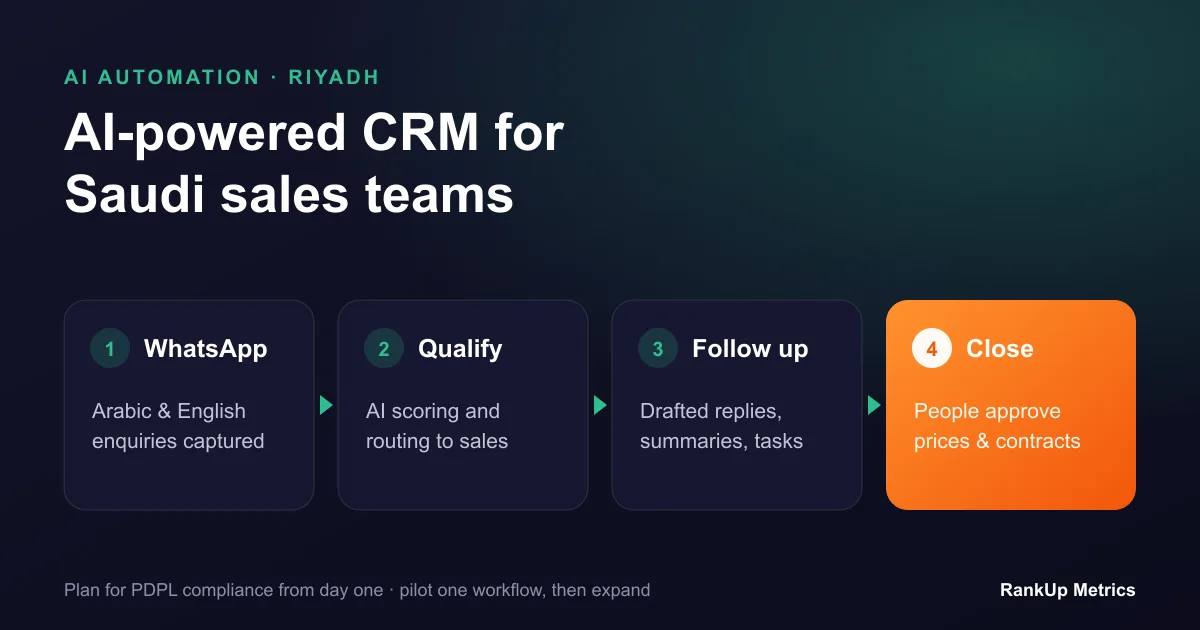
In practice, that layer does four things:
- Understands messages in Arabic and English, including WhatsApp, email and web forms.
- Classifies and prioritises enquiries by intent, product and urgency.
- Drafts and summarises, such as reply suggestions, call summaries and follow-up emails.
- Triggers workflows, such as assigning a lead, creating a task or updating a deal stage.
The important word is "helps". The best implementations keep a person in charge of anything that commits the business, such as prices, discounts and contracts.
Read more: How to Choose CRM Software: A Practical Buying Guide
Seven Use Cases That Pay Off Quickly
1. Arabic and English WhatsApp lead capture
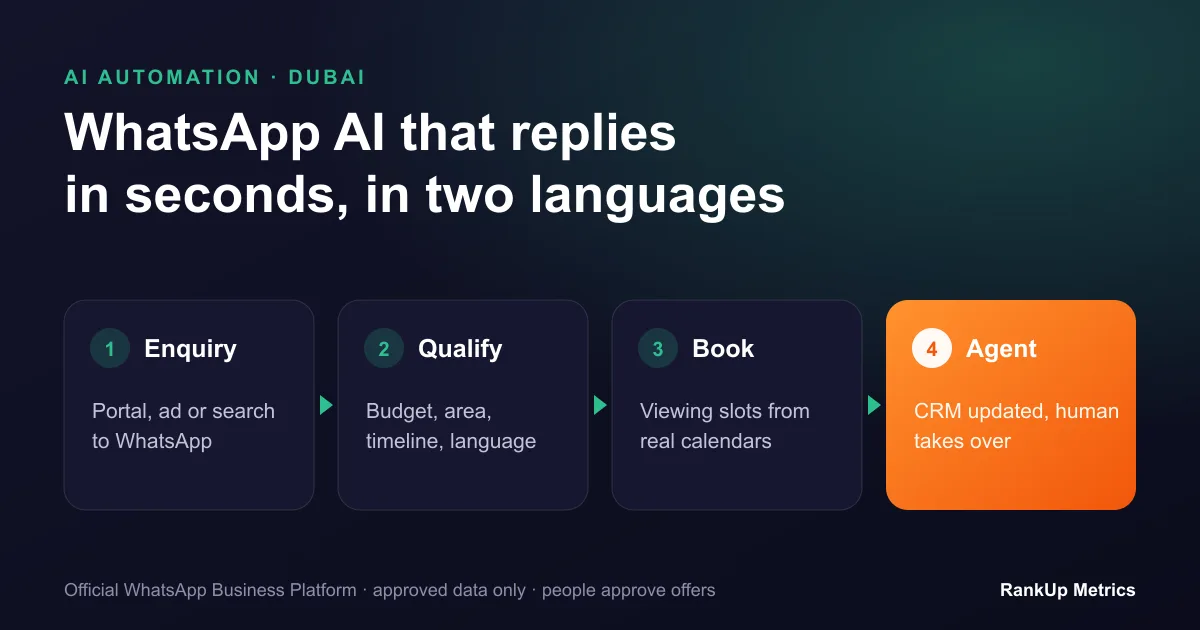
Many Saudi customers start on WhatsApp. An AI assistant connected through the official WhatsApp Business Platform can greet enquiries in the customer's language, ask two or three qualifying questions, and create a lead in the CRM with the conversation attached.
2. Lead scoring and routing
AI can score each enquiry on intent signals such as product, quantity, timeline and company size, then route it to the right salesperson or branch. High-value leads reach a person within minutes instead of waiting in a shared inbox.
3. Follow-up drafting
After a call or meeting, the CRM drafts a follow-up in Arabic or English with the agreed next steps. The salesperson reviews, edits and sends. This is often the single biggest time saving for busy teams.
4. Conversation and call summaries
Long WhatsApp threads and call notes become short summaries on the contact record, so anyone picking up the account understands the history in seconds.
5. Support ticket triage
Existing customers asking about orders, invoices or after-sales service are recognised and routed to support, with order details pulled from your ERP where it is connected.
6. Quotation preparation
AI can pre-fill quotations from the CRM and product catalogue for a salesperson to check. Pricing rules and approvals stay with your team.
7. Pipeline insights
Weekly summaries highlight deals that have stalled, leads that were never contacted and the sources that produce the most qualified opportunities.
Data Protection and Compliance in Saudi Arabia
AI in a CRM handles personal data, so compliance needs attention from the start. Saudi Arabia's Personal Data Protection Law (PDPL), overseen by the Saudi Data and AI Authority (SDAIA), sets rules for collecting, processing, storing and transferring personal data.
Before rollout, work through these questions with your legal or compliance adviser:
- What personal data will the CRM and AI features process, and for what purpose?
- Where is the data stored and processed, and does any of it leave the Kingdom?
- How do customers consent to messaging and automated processing?
- Who can access conversation data, and how long is it kept?
- Can you respond to customer requests to access or delete their data?
If invoices are created from CRM data, your ERP or invoicing system also needs to meet ZATCA e-invoicing requirements. This article is general guidance, not legal advice.
Build, Buy or Extend?
Most Saudi businesses choose between three routes:
| Route | Works well when | Watch out for |
|---|---|---|
| Buy an AI-enabled CRM | Standard sales processes and a small team | Arabic quality, WhatsApp limits and data location |
| Extend your current CRM | A CRM that already works, with gaps in automation | Integration effort and licence costs for AI add-ons |
| Build custom workflows | Complex processes or tight ERP integration | Ownership, maintenance and clear scope |
Test Arabic quality with your own real messages before deciding, including Gulf phrasing and mixed Arabic and English. Generic demos are usually in English.
A 90-Day Rollout Plan
Days 1–30: map and prepare. Document how enquiries arrive and where they get stuck, clean existing contact data, agree lead stages and scoring rules, and confirm compliance requirements.
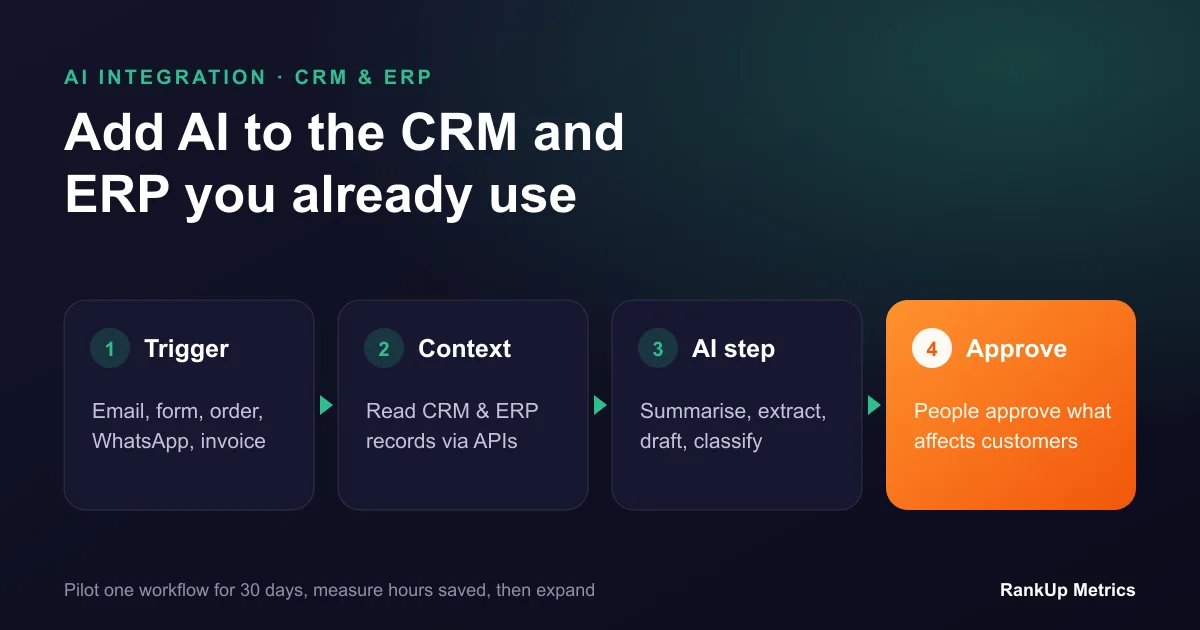
Days 31–60: pilot one workflow. Start with the highest-volume channel, usually WhatsApp lead capture and routing. Run it with a small team, review every AI-drafted reply, and measure response time and qualified leads.
Days 61–90: expand carefully. Add follow-up drafting, summaries and reporting, connect the ERP where it helps, and train the wider team. Keep human approval for pricing and commitments.
Measure success with a few clear numbers: time to first response, percentage of leads contacted, qualified opportunities per week and hours saved per salesperson.
Example Workflow: From WhatsApp Message to Qualified Deal
Here is how a typical enquiry flows through an AI-powered CRM for a Riyadh distributor of commercial kitchen equipment:
- Message arrives on WhatsApp in Arabic asking about combination ovens for a new restaurant.
- The assistant replies in Arabic, confirms the request and asks two questions: expected opening date and number of covers.
- The CRM creates a lead with the conversation attached, tags the product category and scores it as high intent because of the opening date.
- Routing assigns the lead to the salesperson who covers restaurants in Riyadh and notifies them on their phone.
- The salesperson calls within minutes, and the CRM drafts a call summary and a follow-up message with the agreed next step, a showroom visit.
- The quotation is pre-filled from the product catalogue for the salesperson to check, with pricing approval following the company's normal rules.
- Weekly reporting shows response time, conversion by source and stalled deals, so the manager can coach the team.
At no point does the AI set prices or commit the business. It removes the sorting, typing and chasing.
Questions to Ask an AI CRM Vendor
- Can we test Arabic understanding with our own real messages, including Gulf phrasing and mixed languages?
- Does the WhatsApp integration use the official WhatsApp Business Platform?
- Where is our data stored and processed, and can we choose the region?
- Which AI features can be switched off or limited by role?
- How are AI-generated replies reviewed before customers see them?
- What does it cost as volume grows, including messaging and AI usage fees?
- Can it connect to our ERP, accounting and e-invoicing systems?
- How do we export our data if we leave?
Frequently Asked Questions About AI-Powered CRM
Is an AI-powered CRM only for large companies?
No. Small and mid-sized Saudi businesses with busy WhatsApp channels often see the fastest benefit, because a few hours saved per salesperson each week makes a visible difference to a small team.
Will AI replace our sales team?
No. AI handles sorting, drafting and summarising. Building relationships, negotiating and approving prices stay with people, and that is where your team's time should go.
Can AI handle Arabic as well as English?
Modern AI models handle Arabic well, but quality varies by product and dialect. Always test with your own real conversations before committing.
How long does it take to set up?
A focused pilot, such as WhatsApp lead capture and routing, can usually run within a few weeks. Full rollouts with ERP integration take longer and benefit from a phased plan like the one above.
Bringing It Together
An AI-powered CRM is worth it when it removes the slow, repetitive parts of selling: sorting messages, chasing follow-ups and writing summaries, in both Arabic and English. Start with one workflow, keep people in charge of commitments, and treat data protection as part of the design.
We design and build these workflows as an AI automation agency in Riyadh, from WhatsApp lead capture to CRM and custom ERP integration. We also support UAE businesses through AI automation in Ras Al Khaimah. Contact us for a free consultation on where automation would help your team first.